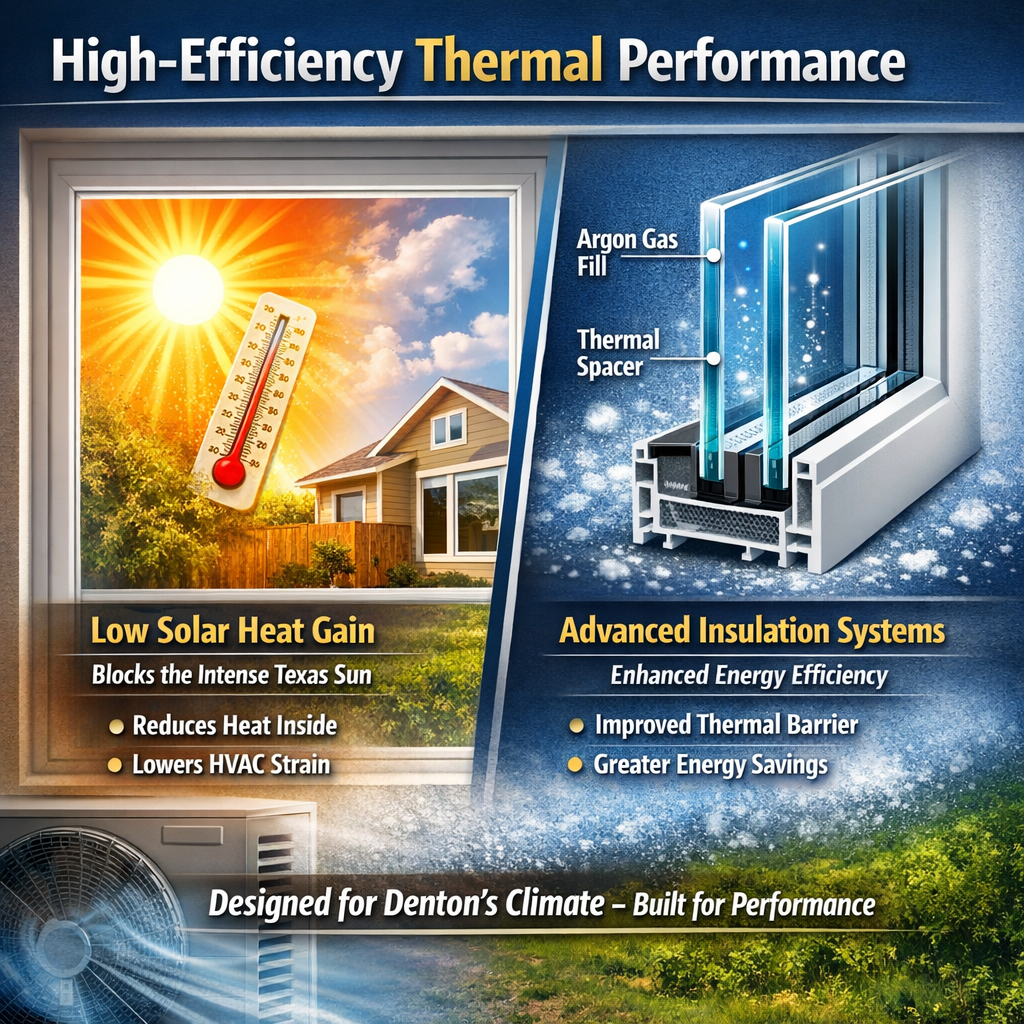
Energy-Efficient & Insulated Windows
Texas weather is hard on windows. A Denton home might see a 90-degree temperature swing between January and August, and your windows are the thinnest part of your building envelope — the place where your conditioned air most easily escapes and outside heat most easily enters. If your energy bills feel disproportionate to your square footage, your windows are a reasonable place to start looking.
These answers cover the technical terms you’ll encounter when shopping for energy-efficient windows, what they actually mean for a North Texas home, and what kind of savings are realistic to expect.
What actually makes a window “energy-efficient”?
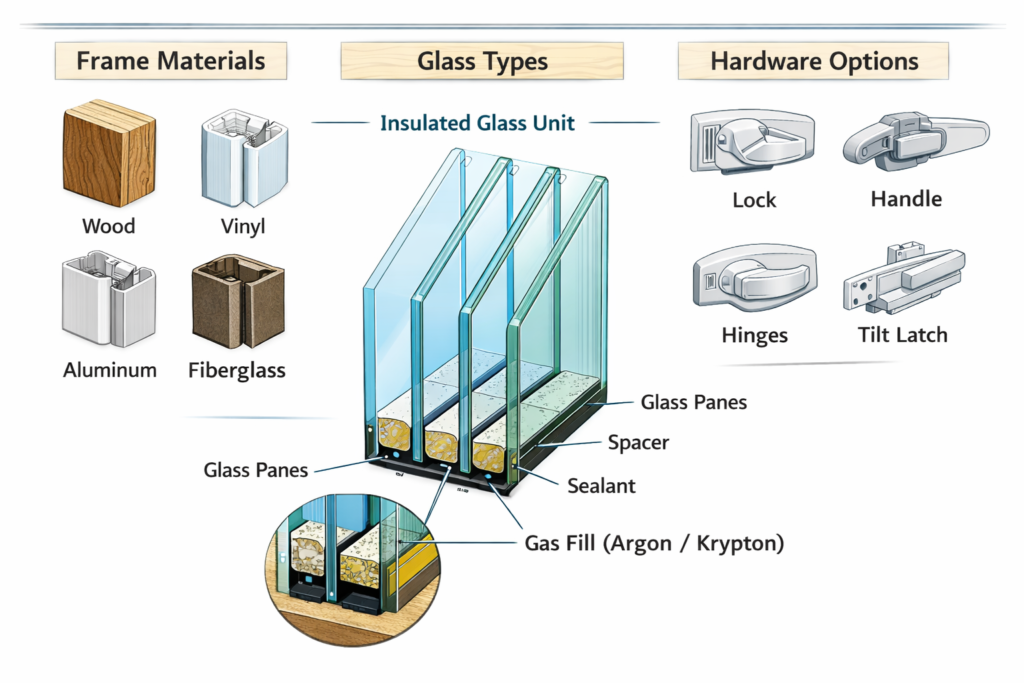
The term gets used loosely, but it has a specific technical meaning. An energy-efficient window controls heat transfer through three mechanisms: the glass itself (its coating and composition), the gas fill between panes, and the frame material. A window that performs well on all three simultaneously earns an ENERGY STAR certification for its climate zone.
In practical terms, an energy-efficient window keeps your HVAC system from working overtime. A home in Frisco or Plano with single-pane original windows can lose or gain heat through the glass at a rate that makes your air conditioner run almost continuously on a 100°F afternoon. A properly specified double-pane low-E window cuts that heat transfer dramatically — not because of marketing, but because of physics.
What is low-E glass, and do I actually need it in Texas?
Low-E stands for low-emissivity. The glass has a microscopically thin metallic coating — invisible to the naked eye — that reflects infrared heat rather than allowing it to pass through. In Texas, the coating’s primary job is to reflect the sun’s heat back to the outside before it enters your home.
There are different low-E formulations, and this is where the details matter for a North Texas climate. A “hard coat” low-E is baked into the glass and is more durable, but less effective at blocking solar heat gain. A “soft coat” low-E (also called sputtered coating) is applied in a vacuum and is significantly better at blocking heat, which is exactly what you want in Denton, Corinth, or Addison where cooling loads dominate for eight or nine months of the year.
The practical upshot: In North Texas, you want a low-E coating specifically optimized for solar heat rejection, not just thermal insulation. Ask your window supplier for the SHGC rating (explained below) — that number tells you how much solar heat the window blocks.
What is U-factor, and what number should I look for?
U-factor measures how quickly a window conducts heat — lower is better. It’s the inverse of R-value, which you may know from insulation. A single-pane window has a U-factor around 1.0. A decent double-pane window might be 0.30. A high-performing unit can reach 0.20 or below.
For ENERGY STAR certification in the North-Central climate zone (which covers DFW and most of North Texas), the U-factor threshold is 0.30 or lower. That’s a reasonable target for most homeowners in Lewisville, Carrollton, or Flower Mound. If you’re in a home with a lot of window area — a south-facing great room with floor-to-ceiling glass, for example — pushing toward 0.25 or below is worth the incremental cost.
What is SHGC, and why does it matter more than U-factor in Texas?
Solar Heat Gain Coefficient (SHGC) measures how much of the sun’s solar radiation passes through the window as heat. It’s expressed as a number between 0 and 1 — lower means less solar heat entering your home. For a climate like DFW’s, where you’re running air conditioning for the better part of nine months, SHGC is arguably more important than U-factor.
ENERGY STAR’s requirement for the North-Central zone is an SHGC of 0.25 or lower. A window with an SHGC of 0.20 will block 80% of solar heat — meaning a south- or west-facing window in a Plano or Grapevine home lets in a fraction of the heat it would with an uncoated pane. The tradeoff is that a very low SHGC also reduces passive solar warming in winter, but in North Texas, that’s almost always the right tradeoff to make.
Double-pane or triple-pane — which is right for a North Texas home?
Triple-pane windows are the right answer for climates where winter heating loads dominate — think Minnesota or Colorado. In North Texas, double-pane windows with the right low-E coating and gas fill perform nearly as well as triple-pane for our actual climate conditions, at a meaningfully lower cost and weight.
Triple-pane units are heavier, which puts more stress on the window hardware and the rough opening framing over time. They’re also 20 to 40 percent more expensive than comparable double-pane units. For most homeowners in Denton, Corinth, The Colony, or Addison, a well-specified double-pane window is the better value. If you have a specific application — a large north-facing window in a home where winter heating costs are a real concern — triple-pane may be worth discussing. But it shouldn’t be a default recommendation for a Texas home.
What is argon gas fill, and does it make a real difference?
Argon is an inert gas that fills the space between the panes in a double or triple-pane window. It conducts heat more slowly than air, which improves the window’s overall U-factor. Krypton gas is even more effective but significantly more expensive, and it’s typically reserved for triple-pane applications where the space between panes is narrower.
For a standard double-pane window, argon fill typically improves the U-factor by about 10 to 15 percent compared to an air-filled unit. That’s a real improvement, and most quality double-pane windows include argon fill as a standard feature rather than an upgrade. Confirm it’s included in any window you’re considering — it should be standard at this point, not an add-on.
How much will energy-efficient windows actually lower my utility bills in Texas?
Honest answer: the savings vary significantly based on what you’re replacing. If you’re upgrading from single-pane original windows in a Denton home built in the 1970s, the Department of Energy estimates you can reduce heating and cooling energy loss through windows by 25 to 30 percent. In a Texas home where cooling costs are substantial, that can translate to $200 to $400 annually for a typical 2,000-square-foot home — though your actual number depends on your current windows, your home’s orientation, and your utility rates.
If you’re replacing relatively modern double-pane windows from the early 2000s with current high-performance units, the savings will be more modest — perhaps $100 to $150 per year. Energy-efficient windows are worth doing for comfort and home value reasons even when the pure energy math is modest, but you should go in with realistic expectations rather than projections that assume dramatic returns.
Are there tax credits or rebates available for energy-efficient windows in 2025 and 2026?
Yes, and this is worth understanding before you buy. Under the Inflation Reduction Act, the Energy Efficient Home Improvement Credit (IRS Form 5695) allows homeowners to claim 30% of the cost of qualifying windows, up to $600 per year for windows and skylights combined. To qualify, the windows must meet ENERGY STAR’s Most Efficient criteria — which is a higher bar than standard ENERGY STAR certification. Confirm with your window supplier that the specific products you’re purchasing meet this threshold, and keep your receipts and product documentation.
Texas utilities — including Oncor and CoServ, which serve much of the Denton and DFW area — periodically offer rebates for qualifying window replacements, but these programs change frequently. Check directly with your utility provider before installation. The federal tax credit is more reliable and consistent, but it has an annual cap, so if you’re doing a large project, timing matters.
Important: Consult a tax professional for guidance specific to your situation. The credit applies to the product cost, not labor, and has specific product eligibility requirements that your contractor should be able to document.
What frame material holds up best in the Texas heat?
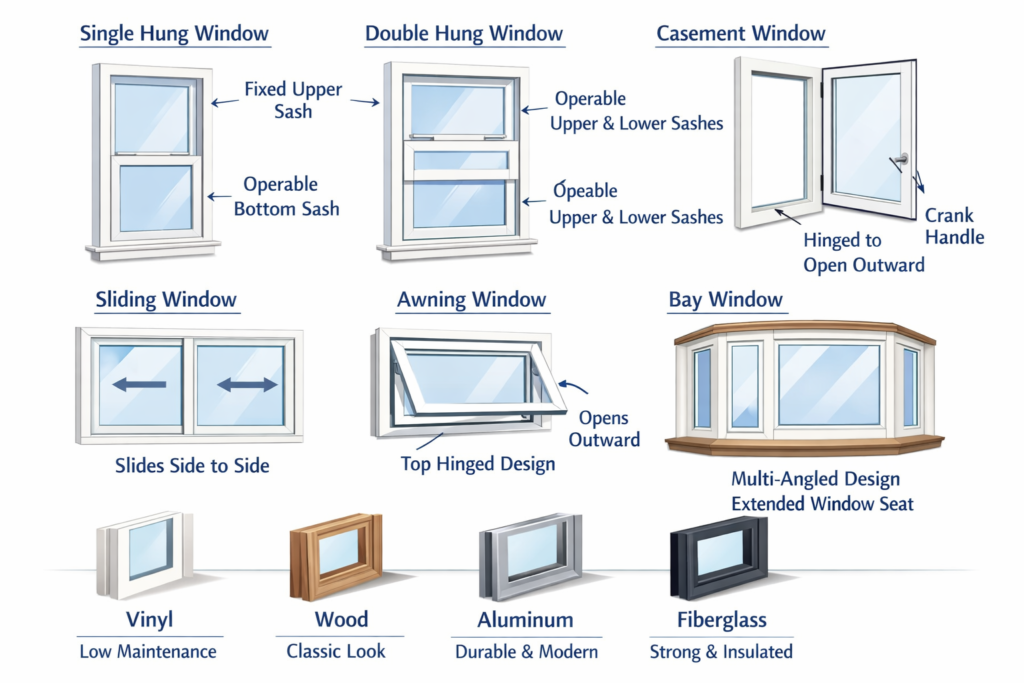
Vinyl and fiberglass are the two materials worth serious consideration for North Texas homes. Wood frames perform beautifully aesthetically but require maintenance in a climate that swings from drought conditions to high humidity — not ideal for most homeowners who want a low-maintenance product.
Vinyl is the most common choice and performs well in moderate temperature ranges. The concern with vinyl in Texas is thermal expansion — vinyl expands and contracts more than other materials, and in a climate with extreme temperature swings, this can affect the seal and hardware over time. Quality vinyl windows from reputable manufacturers account for this, but it’s worth asking about.
Fiberglass expands and contracts at nearly the same rate as glass, which means the seal between the frame and the glass unit stays more stable across temperature extremes. For homes in Frisco, Plano, or Flower Mound that see genuine weather extremes, fiberglass is worth the price premium. Pella’s Impervia line is a strong option in this category. See our energy-efficient windows North Texas page for a deeper comparison.
Do storm windows help, or should I just replace the windows entirely?
Storm windows — secondary windows added to the exterior or interior of an existing window — can improve the performance of single-pane windows meaningfully and at lower cost than full replacement. If your budget doesn’t allow for full replacement right now and your existing frames are structurally sound, interior storm windows are a legitimate interim measure.
That said, storm windows don’t address failed seals, broken hardware, air infiltration around the frame, or frames that are rotted or out of square. They’re a thermal improvement, not a comprehensive fix. For most Denton and DFW homeowners with pre-1990 windows, full replacement ultimately makes more sense than layering storm windows onto aging frames.
How does window replacement pair with door replacement for energy savings?
Windows and doors work as part of the same building envelope, and if your windows are losing energy, there’s a reasonable chance your exterior doors are too. An older sliding glass door in a Corinth or Addison home, for example, often has a single-pane glass unit and minimal weatherstripping — a significant energy loss point regardless of how good your new windows are.
There’s also a practical installation efficiency to doing both projects together: one crew mobilization, one cleanup, and often a better combined price than two separate projects. If door replacement is on your horizon within the next two years, it’s worth discussing with your contractor whether combining the projects makes sense. See our door replacement page for more on what to look for.
Does low-E glass protect against UV fading?
Yes, meaningfully. Low-E coatings block a significant portion of ultraviolet radiation — the primary driver of fading in flooring, furniture, and artwork. A standard soft-coat low-E window blocks roughly 95 percent of UV radiation compared to uncoated glass.
This matters practically for North Texas homeowners with hardwood floors, area rugs, or upholstered furniture near south- or west-facing windows. The fading that would occur over five years with uncoated glass can be substantially slowed with a quality low-E unit. It won’t eliminate fading entirely — some visible light also contributes — but it’s a real, measurable benefit beyond energy performance.
Ready to talk through your options?
Call JBN Windows at 469-340-0834 or request a free quote for your Denton, Corinth, Addison, or DFW home. We’ll walk you through the specific products that make sense for your home’s orientation, your budget, and the Texas climate — not just whatever has the best margin.