Best Window Glass Types for the Texas Climate
Why Texas Windows Are a Different Problem Entirely
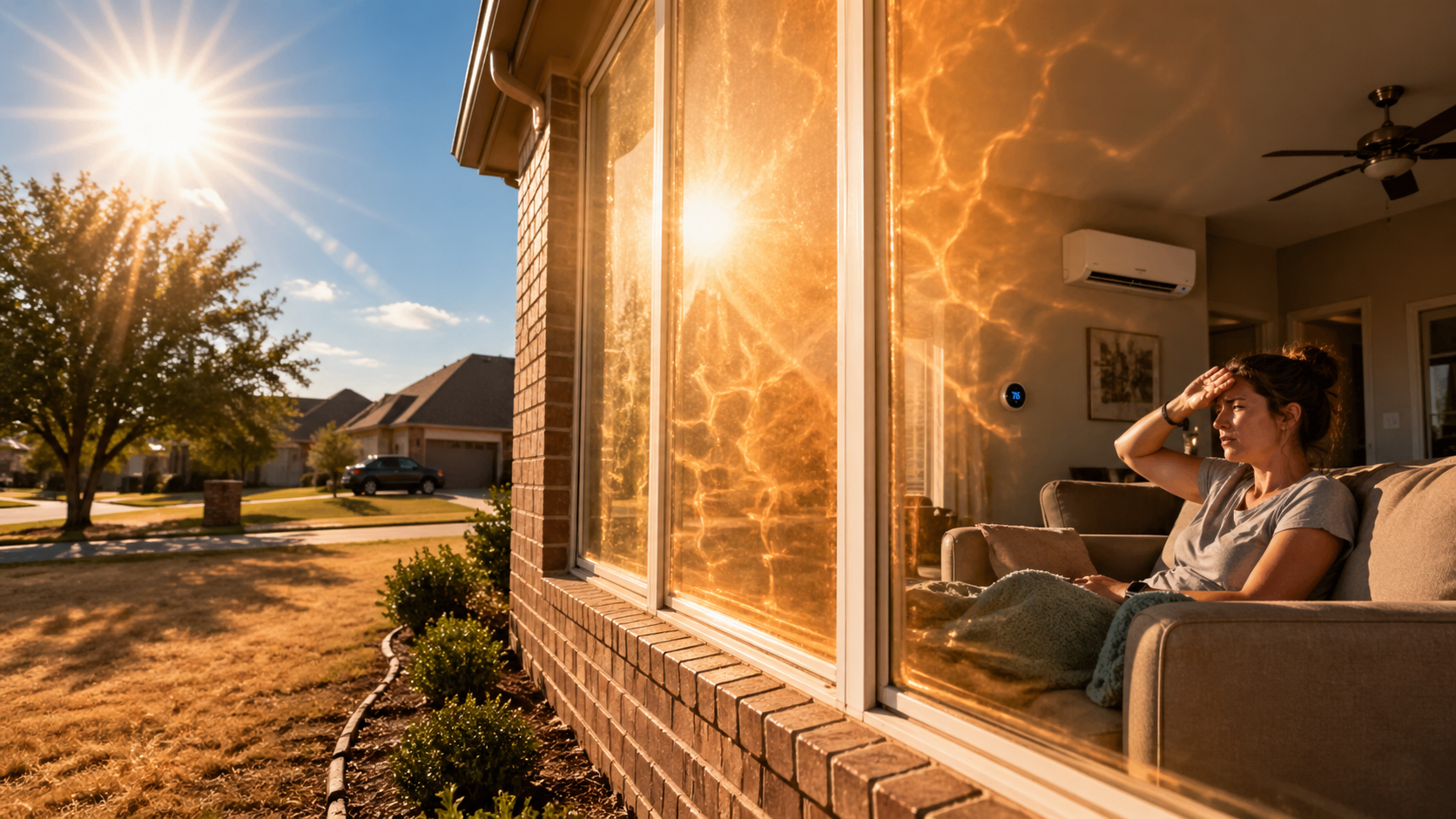
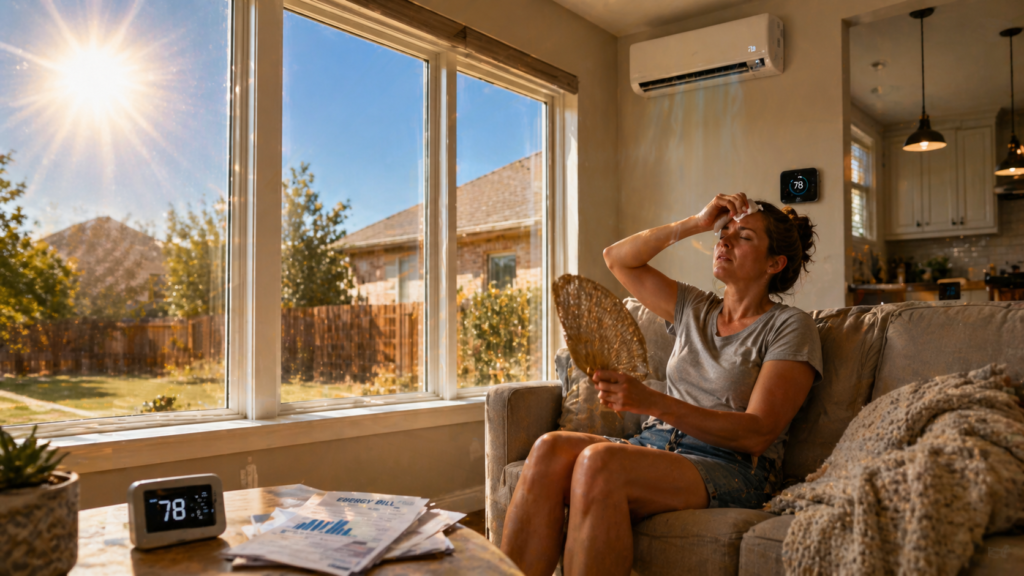
If you’ve ever stood next to a west-facing window in your DFW home on a July afternoon, you already know what we’re talking about. The glass radiates heat like a stovetop burner, your AC runs nonstop, and by August your energy bill looks like a second mortgage. You’re not imagining it — Texas summers are genuinely brutal on homes, and the windows you choose either protect you from that reality or make it significantly worse.
Finding the best window glass types, Texas climate conditions, energy efficiency, utility costs, and home comfort isn’t just about aesthetics or resale value. It’s about making a decision that affects your comfort, your utility costs, and the long-term integrity of your home every single day of the year.
For homeowners dealing with this level of heat, upgrading to energy-efficient window replacement services can make a measurable difference in both performance and monthly costs. You can also explore energy-efficient home improvement credit options to offset installation expenses while improving your home’s efficiency.
The Texas Climate Problem Most Homeowners Misunderstand
Here’s the misconception that costs DFW homeowners the most money: they shop for windows the same way someone in Minnesota or Oregon would. They focus on cold weather insulation, they gravitate toward the heaviest duty triple pane glass, and they assume more insulation always means better performance.
Texas doesn’t work that way.
The Dallas Fort Worth Metroplex sees more than 230 sunny days per year. Summer temperatures regularly push past 100°F, UV exposure is relentless from March through October, and the region swings between dry heat and high humidity in ways that put real mechanical stress on window frames and seals. The problem isn’t keeping cold air in it is keeping solar heat out while still managing the occasional hard freeze in January. If you’re dealing with this, start with a proper evaluation through window replacement services or request a free window replacement estimate to see what actually works for North Texas conditions.
The core challenge in Texas isn’t insulation. It is solar heat gain control. These are related but fundamentally different engineering problems. This is why homeowners across Denton and surrounding areas are shifting toward energy efficient home improvement options that are built specifically for heat rejection, not just insulation.
A window optimized for a cold climate traps heat which is exactly what you want in Wisconsin and exactly what you don’t want in Plano in August. If you’re considering upgrading, focus on systems designed for this region like home window replacement solutions that prioritize heat control, durability, and long term performance.
Decoding the Terminology Before You Talk to a Contractor
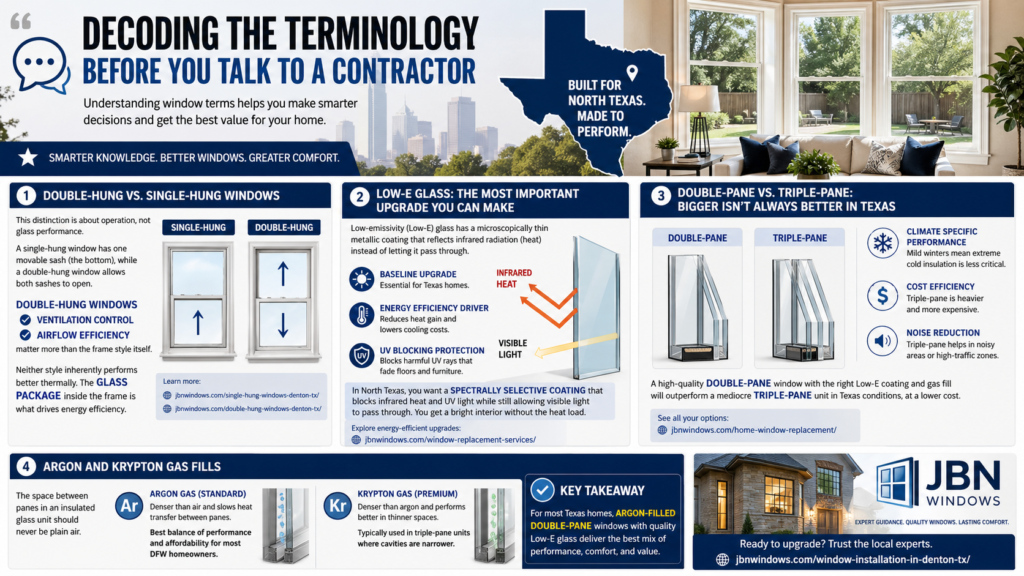
For most homes, double pane windows, climate specific performance, and cost efficiency are the deciding factors.
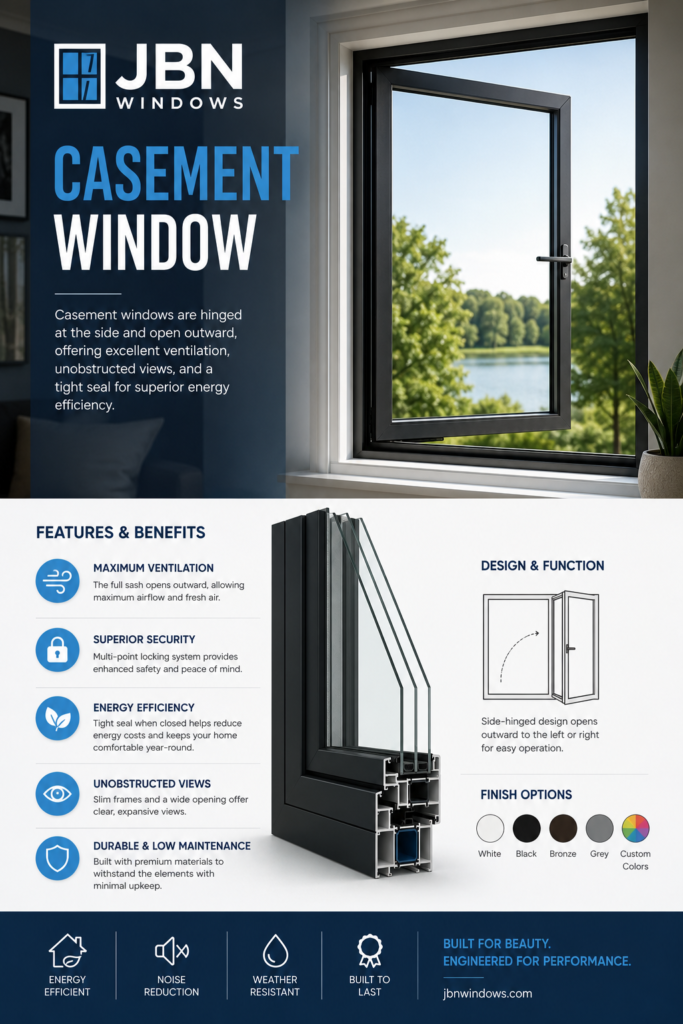
Triple pane units are heavier and more expensive. Their biggest advantage is extreme cold weather insulation, which is less critical in a mild winter climate. A properly built double pane window with high performance Low E glass and gas fill will outperform a poorly designed triple pane unit in this region.
That said, triple pane can still make sense for noise reduction, specialty rooms, or homes exposed to heavy traffic where sound dampening matters.
If you are exploring full upgrades, review
home window replacement options
for a full breakdown of what fits your home best.
Argon and Krypton Gas Fills
The space between panes in an insulated glass unit should never be plain air. Argon gas is the standard because it is denser than air and slows heat transfer between panes. Krypton gas is even denser and is typically used in triple pane units where the cavities are thinner.
For most homeowners, argon gas fill, thermal insulation, and window performance balance are the key factors.
Argon filled double pane windows paired with the right Low E coating deliver the best mix of performance and affordability for Texas homes. Krypton becomes relevant only in higher end triple pane configurations where maximizing insulation in tight spaces is required.
Best Window Glass Types for Texas Climate: What the Ratings Actually Tell You
ENERGY STAR classifies the U.S. into four climate zones, and Texas falls primarily into the South Central zone. That means performance standards are built around intense heat and long cooling seasons, not cold weather efficiency.
For South Central certification, ENERGY STAR requires a Solar Heat Gain Coefficient of 0.25 or lower and a U-Factor of 0.30 or lower. These two numbers are the most important metrics when choosing energy efficient windows for Texas homes.
The U-Factor measures how well a window prevents heat transfer. Lower numbers mean better insulation. The SHGC measures how much solar radiation passes through the glass into your home. Lower values reduce heat gain, which is critical in North Texas summers. A window with an SHGC of 0.20 blocks about 80 percent of solar heat before it enters your home. That directly reduces HVAC strain during peak afternoon temperatures.
For homeowners evaluating upgrades, this ties directly into real performance benefits like lower energy bills and improved indoor comfort. You can explore how this applies to full upgrades here:
https://jbnwindows.com/energy-efficient-home-improvement-credit/
When comparing options, always request the NFRC ratings label instead of relying on brand claims. The National Fenestration Rating Council provides standardized, third party verified data so you can accurately compare different window products.
If you are looking at full replacement or installation options, these ratings should be part of every estimate you receive:
https://jbnwindows.com/window-replacement-services/
And if you want to understand how installation impacts performance just as much as the glass itself:
https://jbnwindows.com/window-installation-in-denton-tx/
Choosing the right glass is not about brand names. It is about verified performance data that matches the Texas climate.
Frame Materials: The Part of the Conversation That Gets Skipped
Glass performance gets most of the attention, but frame material, thermal expansion, UV exposure, and energy efficiency matter more than most homeowners realize, especially in Texas, where constant heat and sunlight create long-term stress on every component of a window system.
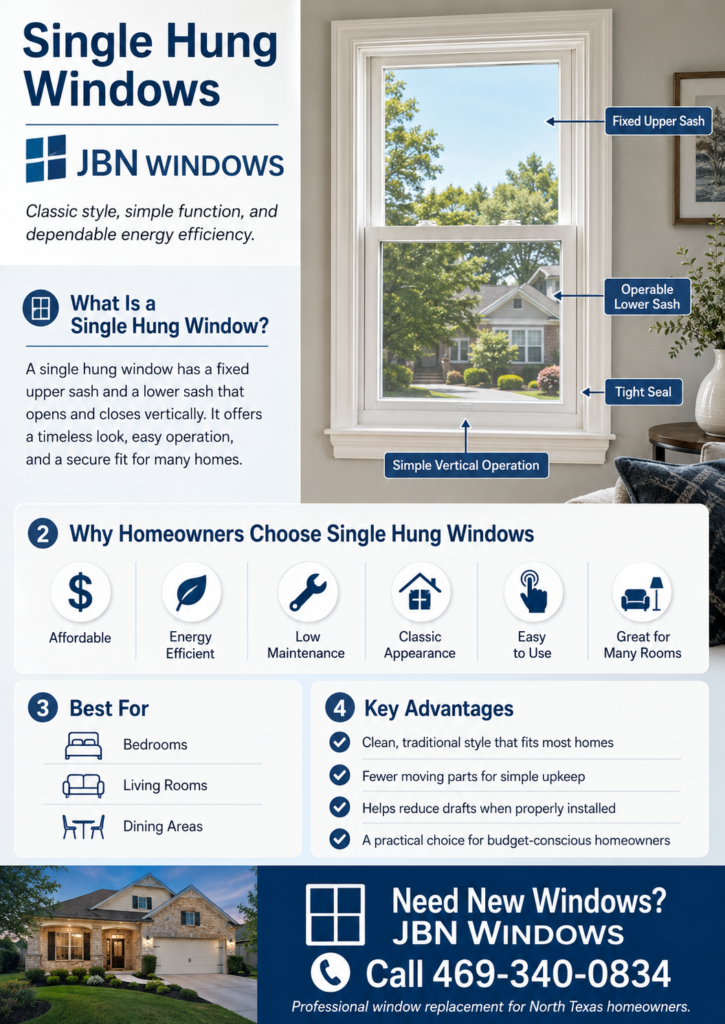
Vinyl frames are the most common choice across DFW for good reason. They do not conduct heat the way aluminum does, they resist moisture, and they hold up well to UV exposure without fading or warping when manufactured to quality standards. Fiberglass frames perform even better thermally and remain dimensionally stable through extreme temperature swings, though they come at a higher price point. Wood frames require more maintenance due to Texas humidity shifts and are generally less practical for exterior-facing applications. Aluminum frames conduct heat rapidly and, without a thermal break built into the design, can undermine an otherwise strong glass package.
For homeowners researching options, reviewing real-world applications like window replacement services helps clarify how different frame materials perform over time in North Texas conditions.
What DFW Homeowners Should Actually Prioritize
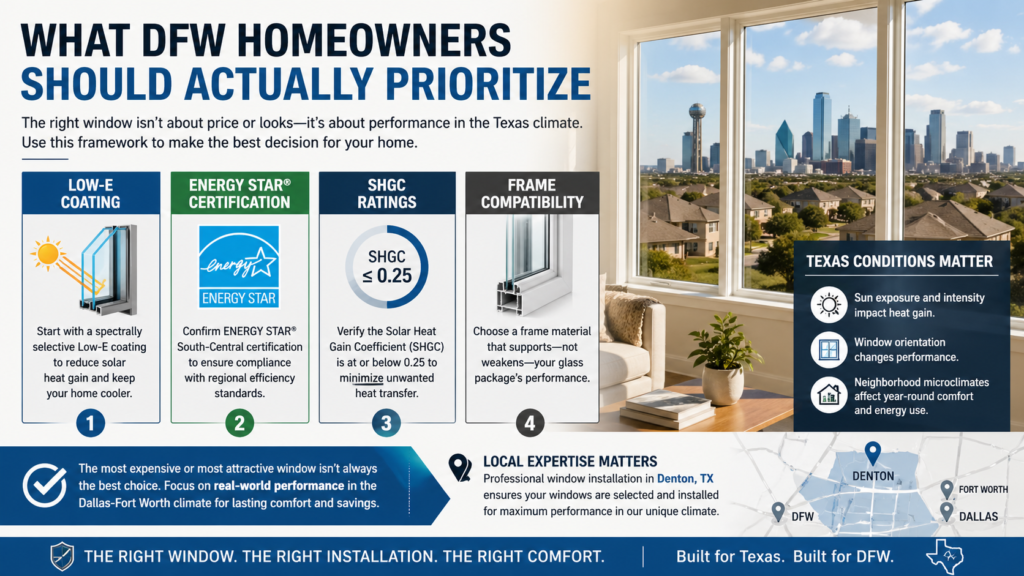
If you are replacing windows in the Dallas-Fort Worth area, the decision framework should center on Low-E coating, ENERGY STAR certification, SHGC ratings, and frame compatibility with your glass package.
Start with a spectrally selective Low-E coating to reduce solar heat gain. Confirm ENERGY STAR South-Central certification to ensure compliance with regional efficiency standards. Verify the Solar Heat Gain Coefficient is at or below 0.25 to minimize unwanted heat transfer. Then choose a frame material that supports, not weakens, that performance.
Many homeowners assume the most expensive or visually appealing window is the best option, but performance in Texas depends heavily on environmental variables. Sun exposure, window orientation, and even neighborhood microclimates all influence how a window system performs year-round.
Exploring localized solutions like window installation Denton TX can provide a clearer picture of how these factors are handled in real installations rather than showroom conditions.
Talk to Someone Who Knows This Climate
The best window systems for Texas are not chosen based on specs alone. They come from understanding local climate, installation experience, and long-term durability under real conditions.
At The JBN Group, we work with homeowners throughout the Dallas-Fort Worth Metroplex to recommend solutions based on how products actually perform over time, not just how they look on paper. If you want accurate guidance tailored to your home, request a free window replacement estimate and get clarity on what will truly work in your environment.